
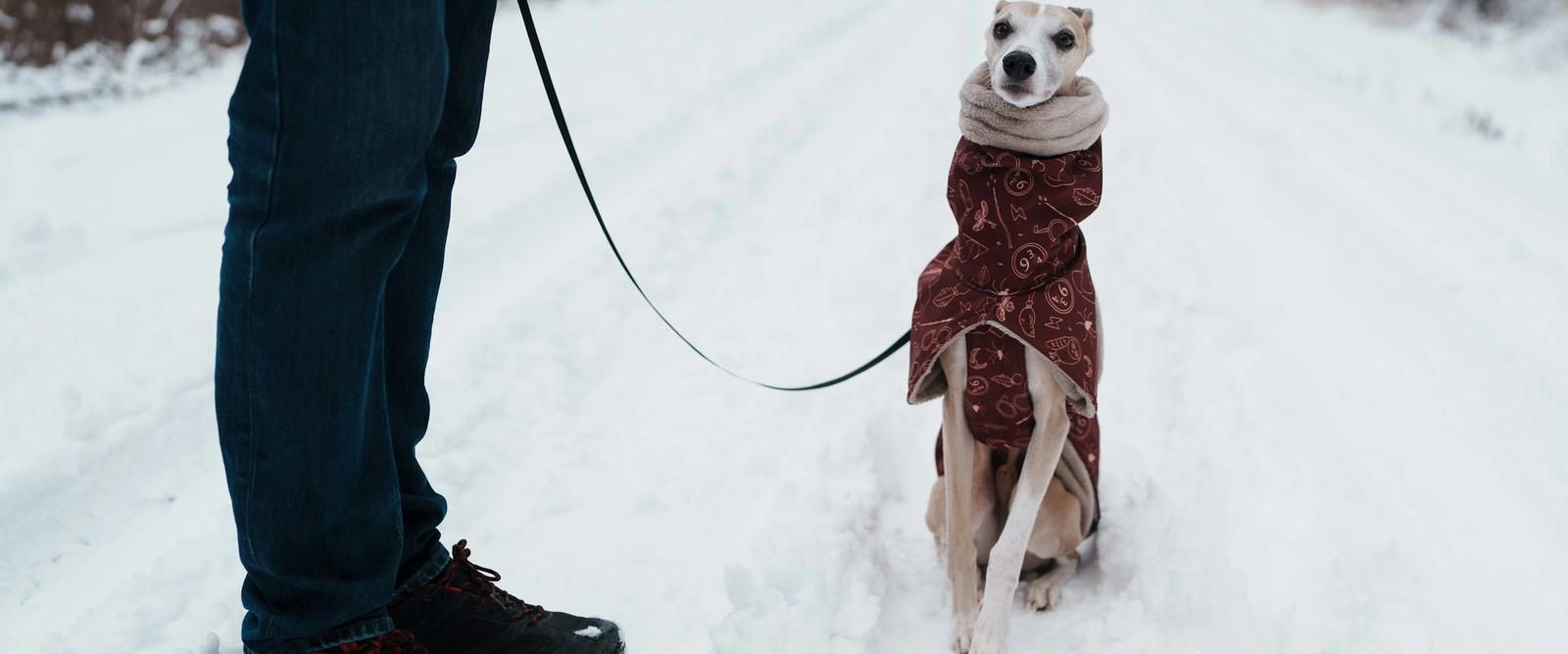
Winter dog walking in Somerset is not for the faint-hearted. It's dark when you leave, the paths are mud, the rain is horizontal, and your gloves are already wet and you've only been outside for four minutes. But it's also (genuinely) one of the best times of year to walk a dog. The paths are empty, the light is low and beautiful when it appears at all, and there's a particular satisfaction in coming home from a wet, windy walk to a warm house and a tired, contented dog.
As a professional dog walker, I don't get to skip the winter walks. Rain, wind, frost, mud: I'm out in all of it, five or six days a week, from November through February. Over the years I've worked out what gear works, which routes hold up, and what genuinely matters for keeping a dog safe and comfortable in cold weather. This guide is what I've learnt. It follows on from the autumn walking guide from a few weeks ago; as the season shifts from golden October to grey November, the advice shifts with it.
If you'd rather let someone else handle the winter walks while you stay warm, I offer solo walks and group walks across Taunton. Your dog still gets their walk, and you don't have to waterproof yourself before breakfast.
1. Does your dog need a coat? A breed-by-breed guide
There's no single answer; it depends on the dog. As a rough guide:
Probably needs a coat: Greyhounds, whippets, and Italian greyhounds (very thin coats, almost no body fat). Small, short-haired breeds like Chihuahuas and miniature pinschers. Older dogs of any breed (they feel the cold more). Dogs with medical conditions that affect circulation or temperature regulation. Any short-haired dog who shivers when standing still in cold weather.
Might benefit from a coat in very cold or wet weather: Short-haired medium breeds like staffies, boxers, and pointers. Young puppies. Dogs who are clipped short (poodles, spaniels in a working clip). Lean, active dogs with low body fat.
Rarely needs a coat: Double-coated breeds (huskies, malamutes, Akitas, German shepherds; they're built for cold). Most retrievers and spaniels with a full coat. Thick-coated terriers. Mountain breeds (Bernese, Newfoundlands, Saint Bernards). Most healthy, active, medium-to-large dogs with a normal coat.
The simplest test: if your dog is shivering, they're cold and need a coat. If they're reluctant to go out, turning back at the door, or holding up a paw after a few minutes, cold is the likely culprit. A wet dog loses heat far faster than a dry one, so a waterproof outer layer matters as much as insulation.
2. Paw care: ice, salt, grit, and balms
Winter surfaces are harder on paws than summer ones. Frozen ground can crack pads. Grit and rock salt sting and dry out the skin, and some dogs lick their paws after a walk and ingest whatever they've walked through. Snow compacting between toes is painful and can cause ice burns.
After a winter walk (particularly on gritted pavements or frozen ground), rinse your dog's paws with warm (not hot) plain water and dry them thoroughly. Check between toes for compacted snow, ice, or grit. A paw balm applied before the walk provides a protective barrier; applied afterwards, it moisturises and helps prevent cracking. Petroleum jelly works in a pinch, but a purpose-made paw balm stays on longer.
If your dog will tolerate them, booties are the most effective protection against salt, ice, and frozen ground. They take some getting used to; introduce them indoors with treats over several days before attempting an outdoor walk. Most dogs adapt within a week.
3. Antifreeze poisoning: the hidden winter killer
Antifreeze (ethylene glycol) is highly toxic to dogs, and it has a sweet taste that dogs find appealing. A spill on a driveway, a puddle in a car park, or a leaking car radiator can expose your dog to a substance that can be fatal in surprisingly small amounts. Even a few teaspoons can be fatal for a small dog; a tablespoon or two can kill a medium-sized dog. If you suspect any ingestion — any amount at all — get to a vet immediately. Do not wait for symptoms.
The early signs of antifreeze poisoning look like drunkenness: wobbliness, vomiting, seeming disoriented, and in some cases, increased thirst and urination. These signs appear within 30 minutes to 12 hours of ingestion. Then the dog may seem to improve for a day or so, which is the most dangerous phase; the apparent recovery masks the kidney damage that's already happening. By the time the dog shows signs of kidney failure (vomiting, lethargy, refusal to eat, collapse), the damage is often irreversible.
If you even suspect your dog has ingested antifreeze, get to a vet immediately. Do not wait for symptoms. Do not "see how they are in the morning." There's an antidote, but it only works if given early enough. Keep antifreeze containers sealed and stored where dogs cannot reach them, clean up any spills immediately, and be cautious around parked cars in winter where radiator leaks are more common.
4. Walking in the dark: lights, reflective gear, and safe routes
By early November, both the morning and evening walks are in darkness. A head torch is your best investment; it keeps both hands free and illuminates the path ahead rather than just a small circle at your feet. For your dog, a reflective collar or harness is the minimum. Better is an LED collar or a flashing tag, particularly for dark-coloured dogs who vanish in low light. If your dog is off-lead in the dark, a flashing light on their collar is essential. You need to know where they are, and so do cyclists and other path users.
Stick to routes you know in the dark. The surfaced paths in Vivary Park, the tarmac section of Longrun Meadow from Silk Mills, and well-lit residential streets are the most practical winter options near Taunton. Woodland walks are atmospheric in theory but treacherous in practice; tree roots, low branches, and uneven ground are harder to navigate when you can't see them.
5. Ice and frozen water: the danger you can't always see
Frozen ponds, lakes, and canals look solid and can be tempting for dogs who don't know any better. They are not solid. A dog who runs onto a frozen body of water can fall through, and once in the water, they can't get back out; the ice breaks under their weight every time they try to climb onto it. Every winter, dogs drown in frozen ponds in the UK. It's one of the most preventable tragedies in dog ownership.
Keep dogs on lead near frozen water. Do not let them onto ice, ever, regardless of how thick it looks. If your dog does go through, do not go in after them; the same ice that couldn't hold your dog won't hold you, and you become the second casualty. Call 999, ask for the fire service, and try to guide your dog towards the shore from the bank. The best strategy is prevention: on-lead near frozen water, every time, no exceptions.
6. Mud management: the boot-wash-and-towel system
Somerset in winter is mud. There is no avoiding it. The trick is managing it so your house and car stay habitable between November and March. The system is: old towel by the back door for a preliminary dry, old towel in the car for the drive home, rinse paws with warm water if they've been through particularly wet or gritty ground, dry thoroughly. If you have an outside tap, a quick paw rinse before the dog sets foot indoors saves your floors.
For the car, a boot liner or an old blanket that can be shaken out and washed is worth its weight in gold. Accept that your car will smell of wet dog from November to February. It's a seasonal feature, not a bug.
The walks that stay least muddy are Vivary Park (tarmac paths throughout), the Longrun Meadow surfaced path from Silk Mills, and French Weir Park's upper path. For guaranteed mud-free exercise, the enclosed dog fields near Taunton are your best bet: book a slot, let your dog run on grass without turning into a mud creature, and go home with a dog who's exercised but not filthy.
7. Which Taunton walks work in winter
Not all of the ten from the main walking spots guide are equal in winter. These are the ones that hold up best from November to February:
Vivary Park. Tarmac paths, flat, well-lit enough for evening walks. The café at The Coffee Station is open year-round for a post-walk warm-up.
Longrun Meadow (surfaced section). The tarmac path from Silk Mills stays walkable in all but the heaviest rain. The field sections turn muddy, but the main path is reliable.
French Weir Park (upper path). Quieter and more sheltered than Longrun. The café at The Weir is open in winter.
The Quantocks (Cothelstone Hill, Lydeard Hill). Surprisingly walkable in winter if you pick your day. The hills drain well, and on a crisp, clear winter day they're spectacular. Avoid in high wind; the exposure is real. Check the forecast before you head out.
Hestercombe Gardens. The paths are well maintained, the café is open in winter, and the woodland provides shelter from wind and rain. A good wet-weather option.
The walks to save for drier days or accept you'll come back muddy: Thurlbear Wood, Netherclay Community Woodland, Castle Neroche, and Otterhead Lakes. All are beautiful in winter but genuinely wet underfoot.
8. How cold is too cold? Temperature guidelines
There's no single temperature at which walks become unsafe. It depends on the dog's size, coat, age, health, and what they're used to. That said, here's a rough framework:
These temperature bands assume dry, calm conditions — wind and wet weather can make it feel 5–10°C colder for your dog.
Above 5°C: Safe for almost all dogs with normal precautions. Small, thin-coated, or elderly dogs may benefit from a coat.
0°C to 5°C: Shorten walks for small, thin-coated, elderly, or very young dogs. A coat is sensible for breeds that need one. Watch for shivering, paw-lifting, or reluctance to keep walking.
-5°C to 0°C: Most dogs still fine for a normal walk with a coat if needed. Shorten walks for vulnerable dogs. Check paws during and after for signs of cold injury. Limit time on frozen ground.
Below -5°C: Short walks only (10 to 15 minutes maximum for most dogs). Vulnerable dogs should toilet in the garden and stay indoors. Booties are worth using if your dog will tolerate them. Frostbite risk is real on paw pads and ear tips in sustained sub-zero temperatures.
Watch for signs of hypothermia in very cold or wet conditions: lethargy, weakness, muscle stiffness, and shivering that stops (a sign of severe hypothermia). A wet dog can develop hypothermia even above freezing in wind and rain.
These are guidelines, not rules. The single best measure of whether your dog is too cold is your dog: shivering, paw-lifting, reluctance to keep moving, or heading for home are all signs it's time to call it. A dog who's running, sniffing, and engaged is fine, regardless of the number on the thermometer.
9. Winter gear for you: what a professional dog walker wears in January
I spend several hours a day outside in winter, so my gear has been tested harder than most. What works: waterproof walking boots (not wellies; they're cold and offer no ankle support on uneven ground), thermal base layers (merino wool is better than synthetic; it stays warm when wet), a waterproof and breathable outer layer (not a fashion coat; a proper walking jacket that you can move in), waterproof gloves (this is the one people get wrong most often; wet hands end a walk faster than anything else), and a buff or neck warmer. A head torch lives in my coat pocket from October to March, even for daytime walks, because the light goes faster than you expect.
If you're going to invest in one piece of winter walking gear, make it waterproof boots. Cold, wet feet make every walk miserable, and Somerset in winter is almost never dry underfoot even when it's dry overhead.
10. Indoor alternatives for genuinely dangerous weather
Some days, the weather is genuinely unsafe for walking: high winds with falling branches, sheet ice on every surface, or flooding that makes the usual paths inaccessible. On those days, the no-walk enrichment guide is your backup plan. Scent work, puzzle feeders, trick training, the cup game, lick mats: ten to fifteen minutes of focused brain work can tire a dog as thoroughly as a walk without anyone setting foot outside.
The key is not to let a dangerous-weather day turn into a nothing day. Your dog still needs engagement, even if they can't have a walk. And if the weather is bad enough that you're skipping walks for more than a day or two, a professional walker with the right gear and vehicle can bridge the gap; that's what I do all winter.
Practical Tips for Winter Dog Walking
Walk in the middle of the day if you can. The warmest, brightest part of a winter day is between 11am and 2pm. If your schedule allows it, shift your walks into this window. The light is better, the temperature is higher, and the walk is more pleasant for everyone involved.
Check paws after every winter walk. Rinse off grit and salt, dry thoroughly, and check between toes. A quick paw check catches cracked pads, ice balls, salt irritation, and the beginnings of skin issues before they become a problem.
Keep a winter kit in the car. Old towel, spare lead, basic first aid kit, blanket, water, and a flask of something hot. If you break down or get caught in weather worse than expected, these things make the difference between a story and a genuine emergency.
Don't let the weather stop you. A wet, cold walk followed by a warm house and a tired dog is one of the genuine pleasures of winter. Dress for it, accept that you'll come back muddy, and go anyway. The dog doesn't care about the rain.
Want someone else to brave the winter weather?
Hi, I'm Emma, the dog walker and trainer behind Dogs and Fairy Tails, based in Taunton. I offer solo walks and group walks across Taunton and the surrounding countryside. Winter walks are part of the job, and I like them more than most. I'm BSc Animal Behaviour qualified, fully insured, DBS checked, and I compete at Crufts in Heelwork to Music and Agility. Your dog gets their walk, whatever the weather, and comes home exercised, towel-dried, and happy.
Book a free meet and greet and let's talk about winter walks for your dog. Or if you'd like to know more about me first, here's the about page.