
Training a dog is not about creating a robot that sits, stays, and heels on command. It's about building a shared language between two different species so you can live together without confusion, frustration, or conflict. A well-trained dog is not an obedient dog. They're a dog who understands what you're asking and wants to do it, because doing it feels good.
I'm a dog trainer as well as a walker and sitter, and I compete at Crufts in both Heelwork to Music and Agility. Training is the thread that runs through everything I do with dogs. This guide is about the training options available in and around Taunton and across Somerset: what they are, who they suit, and how to choose between them. It's also about what makes good training, regardless of the format.
If you're new to the area or new to dog ownership, you might also want to read my guide on what to look for in a dog professional; the same vetting principles apply to trainers. And if you're starting from the very beginning with a new puppy, the puppy walking guide covers those crucial first weeks.
1. Why training matters: more than "sit" and "stay"
Training is often sold as a set of commands: sit, down, stay, come, heel. Those are useful, but they're not the point. The point is that training teaches your dog how to learn, and it teaches you how to communicate with your dog. Every training session builds your dog's ability to focus, regulate their emotions, and cope with frustration. These are life skills, not party tricks.
A dog who can settle on a mat in a café is a dog you can take anywhere. A dog who can recall away from another dog is a dog who can safely be off-lead. A dog who can wait at a door is a dog who won't bolt into traffic. The commands are the surface. The underlying skills (impulse control, focus, emotional regulation) are what you're actually building.
2. Group classes: pros, cons, and what to expect
Group obedience training classes are the most common starting point, and for good reason. They're affordable. They provide controlled exposure to other dogs in a learning environment. And they give you a weekly appointment that keeps training on the schedule rather than sliding down the priority list.
A good group class has no more than six to eight dogs per trainer. The trainer walks around, watches each partnership, and gives individual feedback; they don't just stand at the front and shout instructions. The atmosphere is calm and encouraging, not military. And the methods are reward-based: treats, toys, praise, play. If you walk into a class and see check chains, scruff shakes, or a trainer shouting at dogs, walk straight back out.
The downside of group classes is limited individual attention. If your dog has a specific behavioural issue (reactivity, fear, aggression), a group class is not the right setting. You need one-to-one attention, at least to start. And some dogs find group classes overstimulating to the point where they can't learn. If your dog spends the entire hour barking, lunging, or cowering, a group class isn't helping either of you. Switch to one-to-one and come back to groups when your dog is ready.
3. One-to-one training: when individual attention is worth it
One-to-one training is exactly what it sounds like: you, your dog, and a trainer, working on your specific goals in your specific context. It's more expensive than group classes, but the learning is faster because the session is entirely about you and your dog. Every minute is productive.
One-to-one is the right format when your dog has a specific issue that needs targeted work (recall, lead pulling, reactivity), when your dog can't cope in a group environment, or when you have goals that don't fit a generic class curriculum: competition preparation, for example, or a specific behaviour chain you want to build. It's also the right format if you're short on time and want maximum progress per session.
A good one-to-one trainer spends as much time coaching you as they do working with your dog, because the goal is for you to be able to continue the training between sessions. If the trainer does all the work and you just watch, you're buying a demonstration, not a lesson. Look for someone who hands the lead back to you within the first ten minutes and says "your turn."
4. Puppy training: the critical window
The socialisation window (roughly 3 to 16 weeks) is when a puppy's brain is most receptive to new experiences, and the learning that happens during this period shapes the adult dog. Puppy classes (typically for dogs from 12 weeks, after second vaccinations) cover the basics: sit, down, recall, lead walking. But their real value is in controlled socialisation: meeting other puppies, meeting other people, experiencing novel objects and surfaces in a safe, structured environment. Many vets and the RSPCA now recommend starting puppy classes from 8 weeks (after the first vaccination, in classes with strict hygiene protocols) so the critical socialisation window isn't missed. Check with your vet about what's right for your puppy.
A good puppy class is calm, small, and focused on building confidence. It doesn't involve "puppy parties" where all the dogs are released to play at once; that's chaos, not socialisation. And it doesn't use punishment or force. If you're in or near Taunton with a new puppy, I also recommend reading the puppy's first walk guide, which covers what happens between classes.
5. Agility training: what it is and which dogs love it
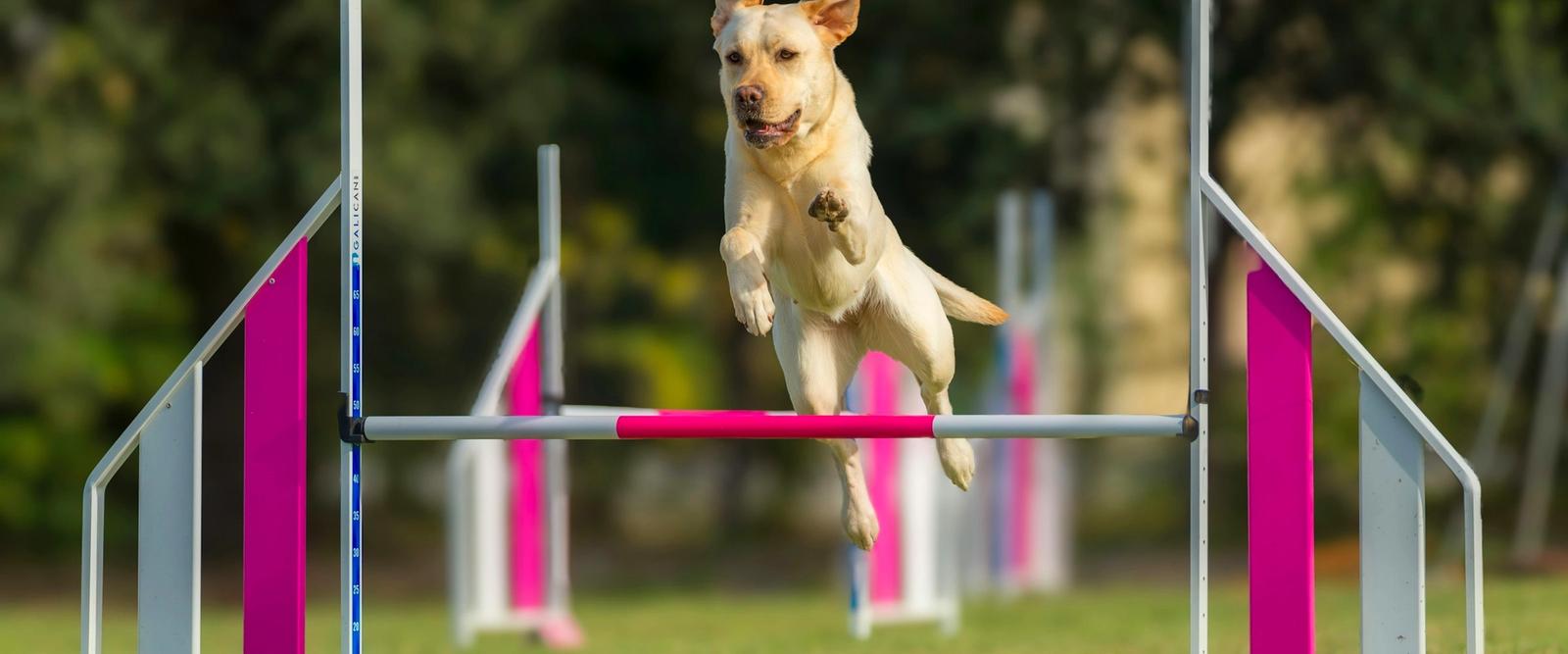
Agility is a sport where dogs navigate a course of jumps, tunnels, weave poles, and contact equipment (A-frame, dog walk, seesaw) against the clock. It's fast, it's physical, and it's one of the best things you can do with a dog who loves to move.
Agility isn't just for border collies. I've seen spaniels, terriers, poodles, crossbreeds, and even a particularly athletic dachshund run agility courses with obvious joy. The prerequisites are basic obedience (a reliable stay and recall), physical maturity (no jumping with open growth plates; usually 12 to 18 months depending on breed), and a dog who enjoys physical challenges.
The benefits go far beyond the course. Agility builds your dog's confidence, body awareness, and ability to follow your direction at a distance. It deepens the partnership between you in a way that flatwork training often doesn't. And it's genuinely fun, for both of you. I offer agility training for dogs who are ready to start, from foundation flatwork to full course sequences.
6. Heelwork to Music: the training you haven't tried yet
Heelwork to Music (HTM) is dog training set to music. It combines precision heelwork, tricks, and choreography into a routine that's part obedience, part dance, part creative partnership. I compete in HTM at Crufts level, and I can tell you from experience: it transforms the relationship between a dog and their handler.
The reason HTM works so well as training is that it demands genuine engagement. Your dog has to watch you, read your body language, and respond to subtle cues while moving through a sequence. It's mentally intense in a way that rewards-based repetition training often isn't. And because it's set to music and built around flow rather than drilling, dogs tend to love it.
HTM suits any dog who enjoys working closely with their person. It's particularly good for dogs who need a job (collies, shepherds, spaniels, poodles), but I've worked with terriers, retrievers, and crossbreeds who took to it beautifully. I offer Heelwork to Music training for all levels, from complete beginners to competitive handlers.
7. Positive reinforcement: what it means and why it works
Positive reinforcement means adding something the dog wants (food, a toy, praise, access to something they like) immediately after a behaviour, which makes that behaviour more likely to happen again. It's not the only training method, but it's the one with the strongest evidence base, the fewest welfare concerns, and the best long-term results.
In practice, it means you reward the behaviours you want and manage the environment so the behaviours you don't want aren't practised. You don't yank the lead when the dog pulls. You reward them when the lead is loose. You don't shout at the dog for barking at the window. You teach them an alternative behaviour (go to your mat, come find me) and reward that instead. It requires more thought than punishment-based training, but the results are more durable and the process doesn't damage your relationship with your dog.
If a trainer tells you that you need to "show the dog who's boss" or "be the alpha," find a different trainer. That model was based on flawed research on captive wolves in the 1940s, popularised in the 1970s, and publicly retracted by the scientist who popularised it in 1999.
8. How to spot a good trainer
The dog training industry in the UK is unregulated. Anyone can call themselves a dog trainer, print some business cards, and start charging. So how do you find the good ones?
Look for accreditation. The Association of Pet Dog Trainers (APDT), the Institute of Modern Dog Trainers (IMDT), and the Animal Behaviour and Training Council (ABTC) are the main UK bodies. Membership doesn't guarantee quality, but it tells you the trainer has met a minimum standard and committed to a code of conduct. Look for a relevant qualification: animal behaviour, psychology, or a dedicated dog-training certification. And look for a trainer who's still learning themselves. The best trainers attend seminars, read the research, and update their methods as the evidence evolves.
Watch a session before booking. A good trainer's classes are calm, organised, and full of dogs who are engaged and happy. The trainer explains things clearly. They're patient with dogs and with owners. They don't get frustrated, shout, or manhandle dogs. Trust what you see.
If your dog's issue is emotional rather than skill-based (fear, anxiety, reactivity), a trainer might not be the right starting point. I've written a separate guide to separation anxiety in dogs that explains when to involve a behaviourist rather than a trainer.
9. How training supports walking and sitting
There's a reason I do all three (walking, sitting, and training) rather than specialising in one. A well-trained dog is easier and safer to walk. They have reliable recall, they don't pull on the lead, they're neutral around other dogs. A well-trained dog is easier to sit for: they settle calmly, they have an off-switch, they don't demand-bark or guard resources. And a walker or sitter who's also a trainer can reinforce your training rather than undermining it.
When the same person does all three, your dog gets consistency. The cues you use at home are the same cues the walker uses on the trail. The settle training you're working on is reinforced during sitting sessions. It's a coherent approach rather than three separate people doing three separate things. This is why I built Dogs and Fairy Tails as an integrated service rather than just a walking business.
10. Combining training with walking: why it works
This is the practical takeaway: if you're working on a specific training goal (loose-lead walking, recall, neutrality around other dogs), having a walker who can reinforce that training on every walk is transformative. Rather than your dog practising pulling with a walker who doesn't know (or doesn't care) that you're working on loose-lead walking, they get consistent reinforcement of the behaviour you want, from every person who handles them.
It's the difference between a walker who simply moves your dog from A to B and a professional who treats every walk as a training opportunity. If this approach appeals, get in touch and we'll talk about what you're working on and how I can support it on walks.
Practical Tips for Starting Training
Short sessions, high frequency. Five minutes of focused training three times a day is far more effective than a single half-hour session once a week. Dogs learn in short bursts, and consolidation happens between sessions, not during them.
Use real-life rewards. Your dog's breakfast kibble is a training opportunity. Hand-feed it on a walk for loose-lead walking rather than putting it in a bowl. The dog works for their food, and you fit training into time you were already spending.
End on a win. Always finish a training session on a successful repetition, even if it's an easier version of what you were working on. Success at the end of a session strengthens the memory of the whole session. Failure at the end weakens it.
Train the dog in front of you. Your dog today is not the dog you'll have in six months. Adjust your expectations to what your dog can do right now, in this environment, with this level of distraction. Comparing your progress to someone else's dog is a recipe for frustration.
Want a trainer who's also your walker and sitter?
Hi, I'm Emma, the dog walker, trainer, and sitter behind Dogs and Fairy Tails, based in Taunton. I offer agility training and Heelwork to Music training alongside my solo walking and group walking services. I'm BSc Animal Behaviour qualified, fully insured, DBS checked, and I compete at Crufts in both disciplines. Training isn't something I do on the side; it's at the centre of everything I do with dogs.
Book a free meet and greet and we'll talk about your training goals. Or if you'd like to know more about my background and approach, here's the about page.